Hi All,
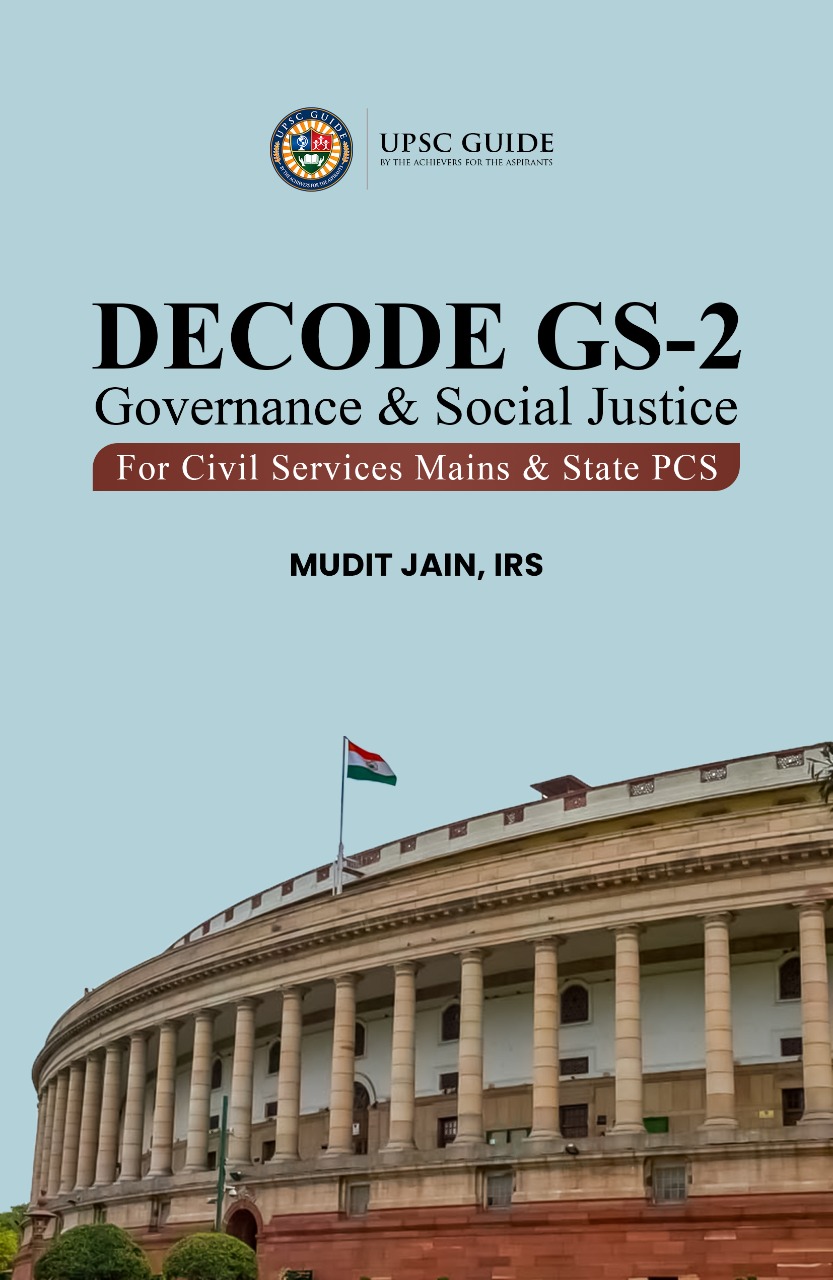
Glad to announce my 3rd Title i.e. Decode GS-2: Governance & Social Justice.
As the name suggests, Decode GS-2 deals with Governance & Social Justice parts of GS-2 Syllabus of UPSC CSE Mains Exam. Also, as many State PCSs have remodeled their syllabus as per UPSC Syllabus, the book will cater to all such PCSs exams too.
Why I wrote Decode GS-2 Book:
- Unavailability of comprehensive, structured yet concise and exam oriented study material
- GS-2 Mains questions are always analytical and require Aspirants to interlink static and current knowledge to write holistic answers. Such material wasn’t available
- Idea is to provide such material and help Aspirants in understanding the art of answer writing for GS-2 paper
Topics Covered in Decode GS-2 Book:
- Pressure groups and formal/informal associations and their role in the Polity.
- Salient features of the Representation of People’s Act.
- Development processes and the development industry- the role of NGOs, SHGs, various groups and associations, donors, charities, institutional and other stakeholders.
- Issues relating to development and management of Social Sector/Services relating to Health, Education, Human Resources.
- Issues relating to poverty and hunger.
- Important aspects of governance, transparency and accountability, e-governance- applications, models, successes, limitations, and potential; citizens charters, transparency & accountability and institutional and other measures.
- Role of civil services in a democracy.
Index of Decode GS-2 Book (Swipe):


Highlights of Decode GS-2 Book:
- Pages: 329
- Bulleted and Numbered Theory
- Current Affairs, Points from ARC/Survey etc
- 2013-2021 Previous Years’ Solved Questions
- 63 Diagrams
- 63 Sample Questions
- Paperback Edition Only
Format of Decode GS-2 Book:
- Static theory linked with Current and Contemporary Affairs for holistic preparation & answer writing
- Theory for topics covers aspects including what, when, why, pro, cons, challenges, schemes and way forward
- Keywords in Bold in every point for easy grasping
- Current Affairs mentioned with grey background so that one can easily identify the same
- Bulleted & numbered content to help you remember/understand points easily & to reproduce in exam
- PYQPs solved & segregated topic wise & mentioned with grey background so that one can easily identify the same
- Solved PYQPs also mention answer structure to help Aspirants brainstorm & break question
- Sample questions at end of each chapter
- Blank page at end of each chapter so that you can include further topic wise current affairs
- Covers highlights from ARC, Budget, Economic Survey and Other Reports
Sample File & Images of Book:


How to Read Decode GS-2 Book:
Being first of its kind book wherein theory is interlinked with current, reading it will be a different experience. My advice to Aspirants is:
- 1st Reading: Just read the book. Do not underline or make notes. Treat current affairs portions just as you treat theory and read them in a flow. Read solved answers and focus on answer structure and how a question is divided into subparts. Get used to the art of making diagrams. Do not solve sample questions.
- 2nd Reading: You may underline now or in the 3rd read. Re-read solved answers and note how the theory is used in answers. Try to make your own diagrams and make structures of sample questions.
- 3rd Reading: Underline and make synopsis or short notes. Solve sample questions.
- Update Current Affairs: You have to refer index and update missing news. I have not mentioned month wise news in book. All I hv done is link relevant current affairs with static theory. If you find other relevant news then note down same in blank pages provided in book after each chapter for this purpose only! There is no particular month till which current is covered in book as book writing is a dynamic process. Broadly, for some topics current is covered till as latest as Feb-March 2022. Focus is on including as much contemporary affairs as possible.
Buy Your Copy Here: https://amzn.to/3RBZqaX
Join Decode Civils Telegram Group For Free UPSC CSE Guidance From Mudit Jain, IRS CSE 2017 (Ex-IPS CSE 2014 & 2015), Author of Decode GS-2, Decode Ethics and Decode History Books
You can reach me at Instagram, LinkedIn, Twitter, Facebook, Youtube and Telegram.
CSE 21 Topper Strategies:
- Surbhi Singla (AIR-75, CSE-21) Comprehensive Strategy
- Sampada Trivedi (AIR-79, CSE-21) Philosophy Strategy
- Ashwin Rathod (AIR-265, CSE-21) Strategy
- Gautam Singh (AIR-549, CSE-21) Psychology Strategy
- Prafull Kumar Sharma (AIR-249, CSE-21) Physics Strategy
- Nivedita R (AIR-572, CSE-21) Geography Strategy
- Asrar Ahmad Kichloo (AIR-287, CSE-21) Prelims, Mains, Interview, Medical Science Strategy
- Abhijit Ray (AIR-50, CSE-21) Learnings and Mains Strategy
- Rijul (AIR-322, CSE-21) Prelims Mains Sociology Strategy
- Vikalpa N Vishwakarma (AIR-275, CSE-21) Prelims Mains and Interview Strategy
- Surbhi Goyal (AIR-78, CSE-21) GS-2 Strategy
- Rishabh Hans (AIR-586, CSE-21) Prelims Strategy
- Neha Byadwal (AIR-260) Prelims, Mains and Economics Strategy
- Prince Kumar (AIR-426, CSE-21) Hindi Medium Strategy
- Himani Singhal (AIR-160, CSE-21) Economics Strategy
- Narayan Amit (AIR-70, CSE-21) Anthropology Strategy
- Devraj Patil (AIR-462, CSE-21) Prelims, Mains, History Strategy
- Pratik Agrawal (AIR-156, CSE-21) Journey and Strategy
- Rachit Kumar Gupta (AIR-286, CSE-21) Chemistry Strategy
- Shubham Shukla (AIR-43, CSE-21) Prelims and Mains Strategy
- Akshay Mahadik (AIR-212, CSE-21) Prelims and Mains Strategy
- Manoj kumar Kannedhara (AIR-157, CSE-21) Prelims Strategy
- Anu beniwal (AIR-217, CSE-21) UPSC Journey & Strategy
- Pratik Mantri (AIR-252, CSE-21) Sociology Strategy
- Prafull Kumar Sharma (AIR-249, CSE-21) Ethics Strategy
- Ravi Kumar (AIR-38, CSE-21) Essay Strategy
- Riju Shrivastava (AIR-124, CSE-21) UPSC Journey and Strategy
- Raj Krishna (AIR-158, CSE-21) Essay Strategy
- Navdeep Aggarwal (AIR-150, CSE-21) Working
- Harshivani Singh (AIR-579, CSE-21) Mental Strength+Prelims+Mains Strategy
- Shubhankar Pratyush Pathak (AIR-11, CSE-21) Maths Strategy
- Mridul Shivhare (AIR-247, CSE-21) Prelims+Mains+PSIR Strategy
- Anjali Verma (AIR-577, CSE-21) Comprehensive Strategy
- Surbhi Goyal (AIR-78, CSE-21) Essay Strategy
- Shubhankar Pratyush Pathak (AIR-11, CSE-21) Comprehensive Strategy
- Arpit Gupta (AIR-54, CSE-21) Prelims, Mains & Maths Strategy
- Anjali Shrotriya (AIR-44, CSE-21) Prelims & Mains Strategy
- Shubhankar Pratyush Pathak (AIR-11, CSE-21) Comprehensive Strategy
- Arpit Gupta (AIR-54, CSE-21) Prelims, Mains & Maths Strategy
- Anjali Shrotriya (AIR-44, CSE-21) Prelims & Mains Strategy
- Shubham Satyam (AIR-497, CSE-21) Detailed Prelims Strategy
- Roja S Rajan (AIR-108, CSE-21) Comprehensive Strategy
- Shubham Bhaisare (AIR-97, CSE-21) Civil Engg. Strategy
- Sparsh Verma (AIR-644, CSE-21) Prelims Strategy
- Nivedita R (AIR-572, CSE-21) Strategy
- Anna Sinha (AIR-112, CSE-21) Strategy
- Pankaj Gujar (AIR-423, CSE 21) Working Professional Strategy
- Hiren Barot (AIR-332, CSE-21) GS & Sociology Strategy
- Antriksh Jain (AIR-130, CSE-21) Sociology Strategy
- Keshav Gupta, AIR- 439 CSE-21 Economics Strategy
- Dilip K Kainikkara (AIR-21, CSE-21) Maths Strategy
Leave a Reply